Monday, March 11, 2013

Wolfpacked Night Create a Movie Project

Wolfpacked night is a mix of both horror and mystery created by Warner Brothers in the 1930's. Our movie's plot follows a detective on the search for a serial killer on the loose one night in the city of Chicago. The twist however is that the wolf is also the detective's brother.
The director our group chose for this project is Michael Curtis. Curtis is a Warner Brothers director who has experience with mystery and horror films. This film is to be produced by Warner Brothers for various reasons. This film is going to be both horror and mystery, both specialties of Warner Brothers. This film's scale is also that of Warner Brother's specialties. It is going to be medium to large scale but not with a huge budget. This is because nearly all shots will be shot in familiar Chicago locations. The reason it is not completely inexpensive is because of the actors.
The main actor in this film will be Paul Moody. His familiarity with audiences will be from Scarface which should make him interesting in a detective role. The main actress will be Anne Dvorak from Scarface as well. Finally the wolf and supporting actor will be played by Boris Karloff from frankenstein. His experience with monster type films should make him perfect for this role. All three actors have experience working with Warner Brothers as well so there will be no trades for staff.
The aspect of the film that will be highlighted in this film will be cinematography. This is for various reasons. One is that the wolf will bever be seen, however implied through the use of shadows. Also, the twisting of camera during violent scenes to avoid gore in the film will be used. The film will also be produced in black and white.

The hays code will affect the making of this film. This film will not be able to use any profanity in the script. Firearms will have to be used sparingly throughout the film. Any type of theft or robbery will also have to be made to be seen as a bad thing. Lastly, Any type of sympathy for the murderer will not be allowed.

This movie is going to be produced for entertainment purposes only and will not have any true moral message behind it. The technology in this film will be common for 1930's film. it will however be a prerequisite for film noir. If I were completely in charge, I would have pushed the limit with the hays code more, using more violent approaches to the murder scenes. I also would have tried to use new technology to produce a wolf since this film is made for entertainment purposes and that could draw in larger crowds.

Sunday, March 3, 2013

Formal Film Study: Scorsese


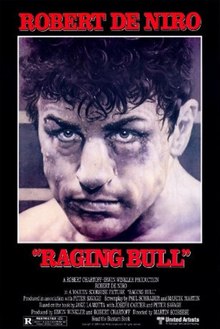
Scorsese is commonly referred to as one of the top directors of film ever. He has an impressive resume` and deserves the acclaim that he has gotten. He comes from an actor of a father and an actress of a mother, neither of whom were as highly acclaimed as Martin himself. His parents were both immigrants from Sicily who settled in New York City. The influence of his heritage is prevalent in many of his films including some of the best like Goodfellas and Casino. Scorsese was also raised a devout catholic and at one point considered giving up his love for cinema to become a preist. The films researched in this film study were Raging Bull, Gangs of New York, and Mean Streets.
The interesting part of studying these films was that each film was a different type of Scorsese film. There was a classic gang film and a film by each of Scorsese's go to actors, DeNiro and DiCaprio. One thing I noticed relative to the plot in many Scorsese films is that the main character who is meant to be portrayed as the tough guy is broken down and shown to be weak. This makes his "gangster" films unique in the fact that the gangster is not portrayed as invincible as in most gangster films. He goes inside the lives of the gangster versus just showing the actions and crime committed by the gangster. He also has a way in many of his films of making you love and hate the main character and different points in the movie. This is again unique becuase in many films in general it is usually one or the other but not both. 
Culture plays a major role in Scorsese's films as well. Scorsese seemed to have a skill of being able to tie in his background with some of the great films he has made. In both raging bull and Mean streets the Italian-American culture is portrayed in a positive light. Subtle messages about the culture itself are made in small scenes or in the background of bigger scenes. The message is sent by showing italian cooking, music, or the importance of family. Rarely have we seen this culture portrayed in a negative light. 
Scorsese also uses shot angles to help emphasize important scenes and important dialouge between characters. Things like using the camera to seem like the viewer is sitting at the table while a conversation are used often when dialogue between three or more characters is taking place. Shots like high angle shots and low angle shots are used in places like stairwells or from the ground to a balcony is used when there is dialogue between two characters taking place.
One main theme I saw prevalent throughout Scorsese's films is his use of dark colors. Many scenes both important and unimportant scenes have a dark color to them. Black background or darkened background is often used to help emphasize characters faces and actions. This is especially prevalent during moments of intense dialogue.

One minor theme I noticed throughout Scorsese's films, is that there often times tends to be moments of intense violence. This is not always unexpected but nevertheless present. I think that it adds to the film's realism and helps make the viewer feel more engaged.

MovieFone. "Martin Scorsese." AOL Moviefone. AOL, n.d. Web. 04 Mar. 2013.
Links to Movie Reviews:
http://www.chicagoreader.com/chicago/mean-streets/Film?oid=1057472
http://www.time.com/time/magazine/article/0,9171,952867-1,00.html
http://observer.com/2003/01/gruesome-never-gratuitous-gangs-of-new-york-rings-true/

Monday, February 18, 2013

MYST Post #1: Two For the Money

Two For the Money
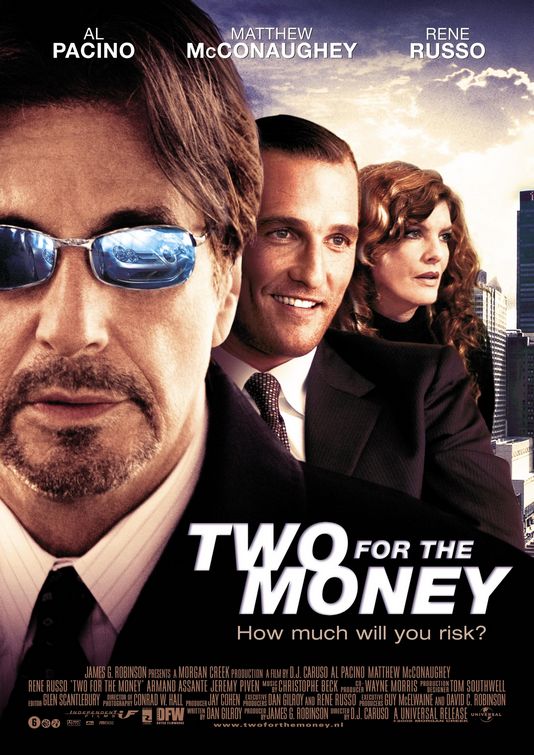
New ground is explored in this movie, Two For the Money, uncovering a new type of sports betting world. In this drama, a new way of sports betting is explored. John Anthony (Mathew McConaughey) is a betting advisor. He works for a company that strictly gives advice to betters putting anywhere from thousands to millions on games. John Anthony starts off as a new raw advisor who quickly earns the respect of his boss Walter (Al Pacino) and Walter's wife Toni (Rene Russo). Anthony has made many clients go from average men, to rich in month's, but his luck does not last. Anthony soon gets big-headed and begins to take a downhill slide.Walter has soon built his company around Anthony and the heat begins to be turned up. Other twists are thrown in as well, like Walter believing Toni and John Anthony are having an affair. Anthony has gotten his clients into trouble and has even lost a clients entire fortune. Anthony soon begins to consider walking away, but he allows himself to advise for one more game, the superbowl. After picking the winner he walks away and goes back home to San Francisco, while Walter finds out the affair never happened. Overall, I would give this movie 3 stars out of 4.
This movie was appealing because of the new territory that it discovered in sports betting. The downfall of Anthony can be confusing however, as it happens quickly and not much is really explained. Al Pacino play Walter extremely well and gives the viewer as sense of importance of himself in the world. The film also does a good job of tricking the viewer into believing that Toni and Anthony are having an affair, but in the end it is explained well how they have tricked you.

Throughout this film, the camera work varies. The director has done a good job of mixing in various techniques to emphasize different things. For example, when Anthony and Walter are sitting in an office talking, there is a side view of the scene so the viewer can see the facial expressions and actions of both people. However, when Anthony is shown working out alone, the view is through a hallway into the workout room with a dark ominous tone, because he has been going through a rough patch. When Toni, Walter, and Anthony are sitting and having dinner together, the camera is placed so that it seems like you are the fourth person at the table, with the camera switching from person to person as they add to the conversation. Overall, the camera work helps the viewer get the sense of what they are supposed to feel from scene to scene.

One particular scene in this film was interesting to me because of the trick pulled on the viewer. In this scene Anthony and Walter are traveling to see a new big client and are in the airport. Walter has a sickness throughout the film where he occasionally has a chest ache and needs to take his medicine right away. In the airport he collapses and it is made to seem as if Walter is about to die. Anthony is flustered and helps Walter take is medicine. Walter whispers in his ear to tell him he is just joking and wanted to make sure he is there for him. It seems to be a sick joke, but it reveals really who both Walter and Anthony really are. This scene keeps the viewer on their toes because the scene starts off relaxed.

Overall, this film was very interesting to me and by far my favorite movie that I have seen from Mathew McConaughey. All actors play their part wel, and the director does a good job of adding the twists in at moments where the movie may be boring otherwise. The people who would like this would be mostly men, from ages 16-45 because it is more of a grown up topic.


Link to Trailer

Thursday, January 31, 2013

"Review of the Reviews"


Reviews of Safe House


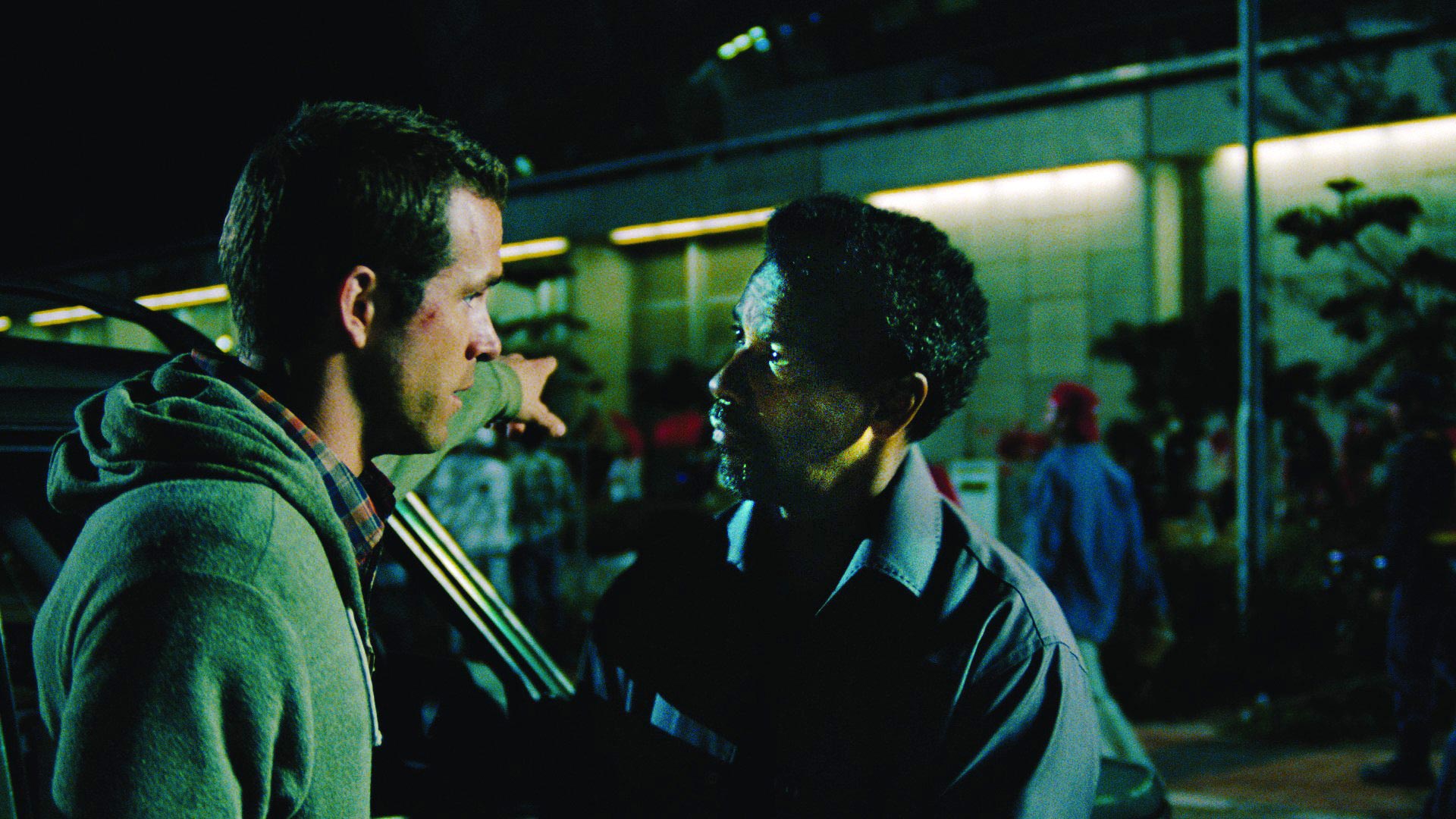
Roger Moore's, a critic from McClatchy Tribune News Service, review of Safe house paints a positive picture for his readers. The author begins by giving the reader background of the film, like main characters/ the actors that play them and the setting. The author also uses direct quotes from the movie to help portray the thrill element that is prevalent throughout the whole film. Then the author goes into detail about his opinion on the film and then finally wraps it up by naming the cast of the film. The writer has an excited tone throughout the whole film. He mentions the excitement the viewer feels as he describes things the chase scenes and gun fights. The writer does not forget to add in the counterargument though. He explains how the director had a grand opportunity to use the scenic backdrop of South Africa, but instead made it more general to seem as if it could be any city worldwide. The vocabulary that the author uses helps add to the tone the author uses. He utilizes phrases like "keeps the movie rolling" to describe how fast paced the movie was. This helps add to the pathos applied to the reader as well. The writer focused mostly on the plot and the techniques the director used to keep the movie on "it's feet." References to other films were brief in this review, only being mentioned in the beginning, vaguely only mentioning how the films plot and action were similar to other films before it. Overall, this review was convincing and made the film more intriguing.
http://rogersmovienation.com/2013/01/05/movie-review-safe-house/

This next article by Rex Reed, of the New York Observer, is an attack on the film. Reed runs through a summary in which he states no real opinion. Then, out of no where, in two short paragraphs he attacks Daniel Espinosa, director of the film, and even decorated actor Denzel Washington, for his role in the film. This author states no counter argument and does not even leave the discussion open for debate. The vocabulary used throughout the review is simple and easy to understand. This adds to the bluntness of the review. The writers tone is negative and relentless in its attack on the film and anyone involved. He goes as far as to question Washngton's credibility for partaking in the film. There are references used in the attack, where the author state how the movie has been done many time before making it "predictable." Overall, I felt the author did a poor job trying to relay his message to the readers and needs to leave it to readers to make up their own minds.
http://observer.com/2012/02/safe-house-experiences-blowback/

"The Photography is state-of-the-Bourne-art-exciting." To me, this is one of the best action films there is. the combination of Denzel Washington's villain role and his Training Day type attitude along with the wit that the film incorporates makes the film exciting throughout. The chase scenes in this film are exciting and keep you on the edge of you seat.

"Even GQ coverboy Ryan Reynolds has bags under his eyes as big as walnuts." I have to agree that throughout the film Reynolds does not look like himself. Usually he is "prettied up" in movies, but in Safe House he is not. I do not agree, however, that this is a bad thing. I believe that this adds to the films realism. He is supposed to play a stressed out, under experienced, low level a FBI agent and the way he looks throughout the film adds to that.


The more convincing argument is produced by Moore in the review first mentioned. This is for a couple of reasons. First, he has a more laid back approach to informing the reader to his opinion. Second, he does not attack those related to the film, especially highly respected actors. The author also allows the reader to form their own opinion and does not tell them what they need to think. I also believe that taking direct quotes from the film helped add to Moore's, a good fast pace, argument. Finally, Moore uses elaborate yet understandable vocabulary that vividly describes key scenes in the movie. 

If I were to write a review of this film, there are a few key things that would need to be included. First, respect would have to be shown to the actors and director that worked hard on the film. Second, I would try to depict scenes that I felt helped add to my argument. I also feel that it is important to leave the discussion open for debate and to recognize that my own point of view is not the only point of view. The counterargument is also not to be forgotten. Addressing the counterargument adds to your ethos as a writer. I would be sure to leave out any criticism of highly commended actors. Overall, the reviews of this film were convincing, and the techniques varied, for a good film. 


https://www.youtube.com/watch?v=1IfQY4fNcnw


Thursday, January 24, 2013

Film Intro Survey

1. What is the first movie that really made a strong impression on you?
Miracle, Being a hockey player, growing up I heard much about the 1980 olympic team, but I never knew what the gold medal really meant to the country.
2. What are your favorite Genres?
Gangster/Crime, Comedy, War, and Mystery/ Thriller
3. What are your least favorite genres?
Animation, Musical, Dark/ Film Noir
4. What are your favorite films?
Miracle, Safehouse, Training day, Goodfellas, Any Given Sunday
5. List three characteristics that make a good film.
Good balance of action and plot, engaging to the viewer, stays relevant to the topic
6. What are your least favorite movies?
Death Race, Pirana, Easy A
7. What are the characteristics of a bad movie?
Not engaging to the viewer, too much plot/ not enough, too little action
8. If you have any favorite viewers name them
Martin Scorcese, Steven Spielberg
9. If you have any favorite actors, list them
Leonardo Dicaprio, Denzel Washington, Robert Dinero
10. List three films that are important for people to see
Zero Dark Thirty, Blood Diamond, The Godfather
11. Whats your oldest favorite film?
The Godfather
12. Whats the best movie you have seen released in the past two years?
Zero Dark Thirty
13. What are the next 5 films on your queue?
Pain and Gain, Iron Man 3, Django Unchained, Flight, and Gangster Squad